What is ROI in Marketing?
MROI is the company’s total profit from all of its Marketing activities from various Marketing channels. Channels may include organic traffic, event sponsorship, content syndication, social media, PPC, and more.
As businesses face increasing customer demands for personalized Marketing experiences across every channel, measuring Marketing Return On Investment (MROI) is more important than ever. From channel-specific MROI to overall MROI, the clearer you can measure it, and the better you can prove its effectiveness, the easier it will be to justify its continued use and budget approval.
Why is measuring Marketing ROI a challenge for most marketers?
Marketing today isn’t just about getting leads or traffic any more. It’s a complex process involving digital and traditional channels with multiple touchpoints.
It’s difficult to prove ROI because it involves tracking multiple variables over a long time. Because it takes longer to gather accurate data, isolating which factors contributed towards increased sales becomes more difficult.
The average length of a B2B sales cycle is six months. Returns on Marketing investments take time to flow through to the bottom line. In an uncertain situation, the pressure is on to prove those returns are on the way, long before they actually arrive.
There are several types of Marketing ROI, just to cite a few:
- Marketing attributed revenue/bookings
- Marketing attributed pipeline generated
- Cost per acquisition (CPA) ratio
- Return on ad spend
- Customer lifetime value (CLTV)
It’s important to understand the differences among different types of ROI so you can choose the right one. But most of these metrics are calculated similarly regardless of which metric you use.
How Do You Calculate MROI?
Marketing ROI is simply a return-on-investment calculation. It looks something like this:
ROI = (Return – Investment)/Investment
Simple ROI = (sales – Marketing cost)/Marketing cost
The formula for ROI is quite straightforward. It’s the financial return generated by your Marketing efforts, divided by the cost of your Marketing investment.
As with any ROI, the goal is to achieve a positive result. Ideally, you want to maximize the return for every dollar spent.
But even with a neat formula, getting precise numbers is rarely that simple in practice, right? So many moving pieces feed into your return calculation: sales that trickle in months after a campaign, longer sales cycles, the influence of seasonality. You think you’ve measured everything, but then someone in sales lands a huge account and you have to wonder how much credit marketing can fairly take—attribution headaches all over again.
It also doesn’t help that the tools we use for measurement can sometimes make the process murkier instead of clearer. Maybe your CRM isn’t synced with your campaign platform, or you’re using spreadsheets that get out of date the second you hit save. There’s always that one stray Google Analytics report that tells a different story than your paid search dashboard. Realistically, getting your data truly aligned takes more patience (and caffeine) than most teams expect. But once you nail that part, making the case for your ROI feels a whole lot less like guesswork—and senior leadership actually starts listening.
How efficient is your investment?
You can track Marketing ROI by looking at the cost or efficiency ratios and see how much money was generated for every Marketing dollar spent.
Cost ratio = Return:Investment
A good marketer will always strive to generate revenue at a lower rate than they spend. An incredible campaign might see a cost ratio of $8 generated for every dollar spent (8:1) with a simple Marketing ROI of 700%.
Common mistakes measuring Marketing ROI
It may seem easy to measure Marketing ROI, but it can be complicated. There’s increased pressure on marketers to prove the return on investment in their initiatives. Some companies establish that they are unlikely to invest in Marketing initiatives with a negative ROI, as the project is harder to justify on financial terms.
The challenge of demonstrating ROI can be even greater for content Marketing which is often focused on the awareness-building and consideration stages of the funnel. Content does its work over the long-term and over the course of several sales cycles. Trying to prove ROI too quickly can sell your strategy short.
Furthermore, marketers say businesses do not understand B2B Marketing ROI. Let’s look at two common challenges and questions that most marketers face.
Focus on short-term results only
We often look at lead generation and revenue when measuring our Marketing ROI. Proving the ROI of demand generation can be challenging, especially for long-term brand-building investments.
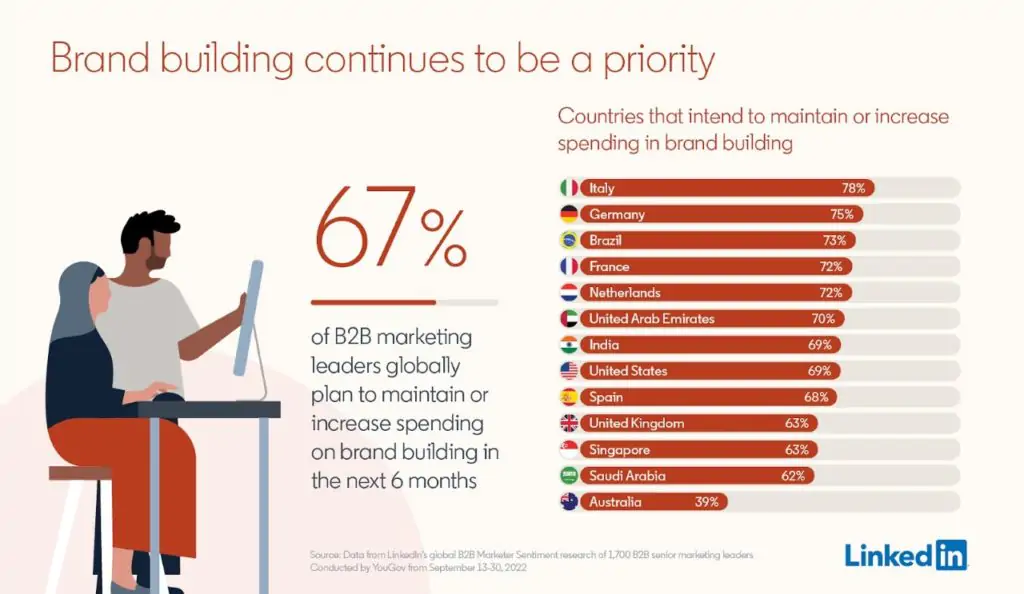
According to the Global B2B Marketing Sentiment Survey research, brand building is the area marketers are most keen to invest in over the next half year. The majority of respondents (67%) plan to increase or maintain their brand spending over the next six months, citing its ability to drive long-term sales (52%) and to keep a brand top of mind for buyers (42%) as their top reasons for doing so.
However, campaigns focused primarily on driving long or medium-term initiatives like branding or retention usually don’t show their full potential for several months or even years.
Digital marketers often measure ROI too quickly. While the average length of a B2B sales cycle is 6 months, only 4% of marketers measure ROI over 6 months or longer according to another LinkedIn research.
It’s important to understand and consider the campaign’s overall goals and duration when measuring ROIs.
ROI and attribution models
You want to attribute revenue to your Marketing channels to determine what kind of return on investment you are getting from those channels.
A common mistake marketers make is not giving enough thought to their attribution method, which will depend greatly on the business model, sales cycles, and Marketing strategies.
Usually, it will take multiple touchpoints before a consumer reaches a buying decision. Most Marketing campaigns will include several touch points across online and even offline channels.
The custom attribution model is usually the best and most sophisticated. A good second choice is a full-path Marketing attribution model as it will help you understand what channels are working best at the top and bottom of your Marketing funnel.
It’s important to avoid getting only a few pieces of the overall Marketing impact puzzle when calculating ROI.
Are you ready to face the ROI challenge?
I hope this article helped you in your ROI measurement challenge. Earning the trust of senior stakeholders and mastering the language of Return on Investment (ROI) is certainly not easy, but it is increasingly important for most marketers today.