Understanding Google’s March 2025 Core Update
Google’s latest core update, announced in March 2025, represents a significant shift in how the search engine giant evaluates and ranks websites. Let’s break it down, gathering insights straight from the source:
Improved Quality Ranking
Google is giving its core ranking systems a boost through algorithmic improvements. The goal? Prioritize the surfacing of the most helpful and relevant information while minimizing unoriginal content in search results. This includes refining ranking systems to identify unhelpful web pages. These are pages with poor user experience or content seemingly created for search engines, not human audiences.
Elizabeth Tucker, Director of Product at Google Search, shares: “This update is more than just algorithm tweaks. It’s a strategic move to reshape the narrative around Google’s search quality. We want to emphasize that AI isn’t the enemy; our focus is on ensuring valuable, relevant content rises to the top.”
New Spam Policies
To combat the rise of spammy, low-quality content, Google is introducing new and improved spam policies. These policies aim to keep the lowest-quality content out of search results. The spotlight is on three key areas:
- Expired Domain Abuse: This targets the manipulation of search rankings by purchasing expired domains and repurposing them for hosting low-quality content.
- Scaled Content Abuse: Google aims to curb the creation of numerous pages primarily for manipulating search rankings, resulting in large amounts of unoriginal and low-value content.
- Site Reputation Abuse: This policy targets the publication of third-party pages with minimal oversight or involvement from the host site to manipulate search rankings.
Reduction of Low-Quality, Unoriginal Results
Building on initiatives from 2022, Google is fine-tuning its ranking systems to reduce unhelpful, unoriginal content. The aim? Identify pages that may seem unhelpful or provide a poor user experience. Also, look for pages created just to match specific search queries.
As we mentioned earlier, the objective is to significantly reduce low-quality, unoriginal content in search results by an estimated 40%.
There’s also a kind of irony with these new filters: sites that relied on shortcuts are suddenly facing the consequences, while those that slowly laid groundwork for real authority—well, some are actually seeing better visibility. No one is pretending these shifts are comfortable (or totally predictable), but the message is clear: just piling up words won’t work anymore, at least not for long. It doesn’t matter if you’ve been racking up keywords or dabbling with AI tools, either; Google’s showing less and less tolerance for fluff. You’ll need actual depth, and some heart behind it, if you want a shot at staying near the top.
Not to say there’s a magic formula, because anyone claiming to have one is probably bluffing, but early reactions from the SEO community show a renewed focus on engagement and intent. Teams that listen to user feedback and revise stale content are, weirdly, having a moment again—almost like things are swinging back to basics, just with stricter rules and higher stakes. The relentless cycle of quick-win hacks is starting to look less appealing now that a single update can erase years of traffic overnight.
Faster Penalties and Inconsistent Communication
A standout feature of this update is the rapid implementation of “manual actions”.
When Google detects a website that fails to adhere to its guidelines, it may impose a “manual action,” resulting in the site’s complete removal from its search results, also known as “deindexation”.
Starting March 5th, there was a noticeable increase in the number of these notifications appearing in the Google Search Console Manual Action dashboard for various sites. The implication of such manual actions is typically the total exclusion of the affected sites from Google’s search results.

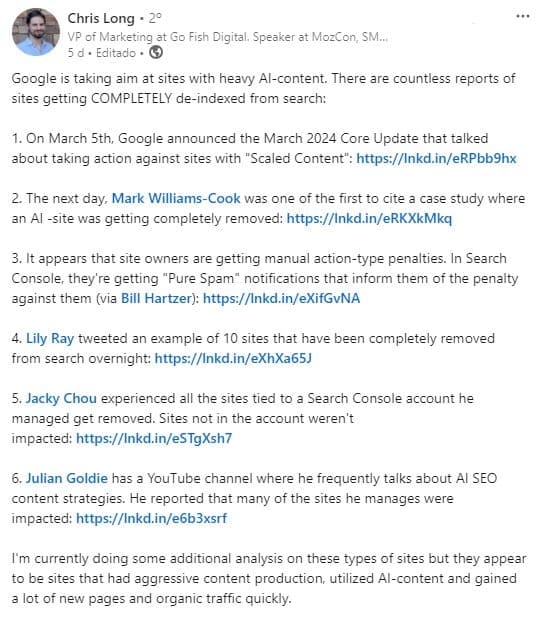
Social media reports indicate instances where sites were completely deindexed, and penalties affecting all pages were applied.
However, there’s inconsistency in communication, with some businesses receiving email notifications, while others spot the manual action in their Google Search Console.
Adding to the complexity of this update, it appears that Google’s approach extends beyond mere penalties to the complete removal of certain websites from its search results. This action seems particularly targeted at sites that predominantly utilize AI-generated content.
Influential figures within the digital marketing sphere have shared stark examples of well-known sites disappearing from Google’s index virtually overnight.
The severity of this measure highlights the critical importance of compliance with Google’s guidelines and the potential perils of relying too heavily on artificial intelligence for content generation.

The AI Discussion on High-Quality Content
It’s important to mention that Google hasn’t made any statement regarding its approach to AI-generated content in search results, but the rule is clear: priority goes to high-quality, helpful, reliable, people-first content.
Barry Schwartz adds, “The specificity of this update is noteworthy. Google is not just penalizing; they’re clearly defining their targets. Scaled content abuse, expired domain abuse, and site reputation abuse are in the spotlight. It’s a call for sites to step up their game.”
Google’s algorithm can discern original, high-quality content that demonstrates expertise, experiences, authority, and trustworthiness (E-E-A-T).
And this is where the March 2025 Core Update intersects with the discussion of AI-generated content.
When we analyze most of the sites that were deindexed in the past week after Google’s update, what we find is a pattern of mass-produced AI-generated content with very little (or none at all) human editing, resulting in generic, shallow, outdated content that violates Google’s spam guidelines, now more than ever.
As Matt G. Southern, Senior News Writer from Search Engine Journal, states: “A decade ago, there were concerns about the rise in mass-produced human-generated content. Rather than banning all human-generated content, Google improved its systems to reward quality content.
Now, Google says it will continue to take a responsible approach toward AI-generated content while maintaining a high bar for information quality and helpfulness in search results.”
Matt’s argument is reinforced by industry expert Giuseppe Caltabiano: “This development serves as a critical reminder for content creators and SEO professionals to focus on producing genuinely valuable content that meets the needs of their audience, rather than resorting to automated solutions that compromise quality for the sake of efficiency.”
Google’s Strategy: Addressing Spam without AI Hostility
Let’s set the record straight – Google is not waging a war against AI. The primary objective is to combat content lacking originality and relevance.
In fact, the update is a targeted effort to eradicate weak, repetitive content, irrespective of whether it’s crafted by AI or other methods.
It’s a call for real content, not a total dismissal of Artificial Intelligence.
Diving deeper into Google’s rationale, it’s not about undermining the potential of AI-driven content but rather ensuring that every piece adds genuine value. The focus lies on removing mediocrity, whether it emerges from automated processes or traditional content creation methods.
Understanding Google’s viewpoint requires acknowledging that AI is a tool, not an adversary. Google’s pursuit is to reward meaningful, engaging content that resonates with users. The intricate dance between algorithms and human-centric content creation is at the heart of Google’s vision for a more enriching online experience.
Celebrating the Human Element
So, as the SEO realm adapts to the winds of change, the message is clear – AI isn’t the enemy; the battle is against mediocrity. Both AI-driven and conventional websites are urged to embrace this shift, prioritizing the substance of their content to navigate through Google’s updates successfully.
At the heart of this narrative is a celebration of the human experience in content creation.
Beth Ashton from The Independent rightly points out, “It’s crucial to find that balance. Google’s push against spam is valid, but there’s a responsibility to collaborate with content creators for a future that stands the test of time. Quick penalties are part of the equation, but equal attention should be given to rewarding quality content.”
In refining algorithms, the goal is not to discard technology but to integrate it with human insight, enriching the content with depth rather than superficiality.
Insights on Content and Authority Post-Update
As pioneers in digital content solutions, we remain at the forefront of guiding clients through these evolving landscapes.
For some time now, we’ve been closely monitoring every change – from the emergence of new AI tools to Google updates and user behavior. We’ve conducted numerous tests and delved into what defines quality content, how to create it properly, and, most importantly, ensure sustainable growth for our clients.
Our insights into content production and authority building post-update are designed to empower businesses to create high-quality content that not only complies with Google’s guidelines but also secures top rankings.
Here we’ll share key findings from our research and practical tips to help you stay ahead in the dynamic digital world.
Expert-Driven Content Plays a Pivotal Role in Driving Organic Traffic Growth
This comparative graph shows the positive impact of expert-driven content on organic traffic growth (for reasons of confidentiality, the client’s names in this study were withheld):

By examining data from multiple clients, we can observe distinct trends: blogs that have consistently implemented expert-driven content from the outset demonstrate a clear pattern of constant growth.
In contrast, those that have gradually introduced expert-driven content show signs of stagnation with occasional fluctuations. Moreover, blogs adhering to traditional SEO strategies without adapting to content specialization are facing a decline in traffic.
These insights underscore the importance of expert-driven content in staying competitive and achieving sustainable growth in the current SEO climate.
Our suggested SEO strategy stands as a testament to rigorous planning and continuous refinement, particularly in response to Google’s algorithm updates.
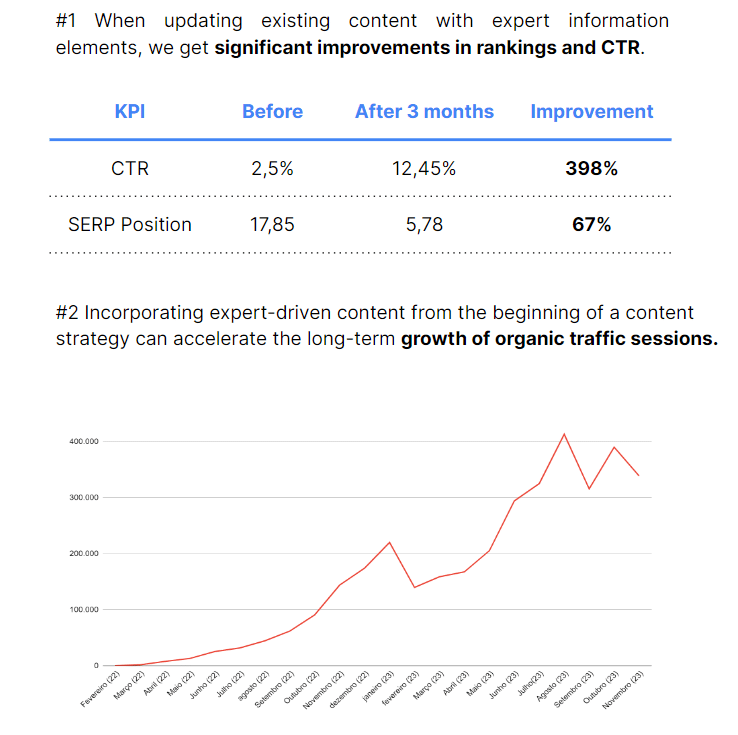
The table above showcases the dramatic improvements achieved in just three months by one of our customers, including a 398% increase in CTR (Click-Through Rate) and a 67% rise in SERP (Search Engine Results Page) positioning.
The graph further illustrates the success of this approach, with a steady ascent in organic traffic sessions. These results not only emphasize the power of expert-driven content but also reinforce our commitment to improving SEO strategies in alignment with Google’s updates.
Expertise, Personal Touch, and Human-Centric Search Experience
In Q2/23, we noticed Google’s algorithm updates emphasizing experiences and expertise, highlighting a move toward a more human-centric search experience. This development contrasts with the rise of AI-generated content, emphasizing the continued importance of human expertise for complex queries and deep analysis.
Our hypotheses suggest that the unique value of expert insight and real-time adaptability remain decisive factors.
To rise above the digital noise, content must be crafted with a personal touch, and be anchored by credible, transparent sources. These are the pillars that give content its edge in a crowded marketplace.
Using this format we achieved results beyond expectations in a scenario in which everyone was losing traffic.
The Power of Synergy: AI and Human Editors Unite
Let’s be clear – AI for content creation is here to stay. Why not combine the strengths of AI with human insights and expertise? Meet our team of content creators and AI experts ready to elevate your content.
Imagine this – a platform designed to lift your content, ensuring it meets Google’s latest standards and guidelines. A guard against spammy content and your key to using AI’s potential without getting penalized.
Wrapping Up
Let’s redefine our approach to Google’s updates; they’re not obstacles but opportunities, guiding content creation toward quality and relevance. It’s a call to embrace collaboration, recognizing that the fusion of AI and human expertise propels us into a new era of content creation.