
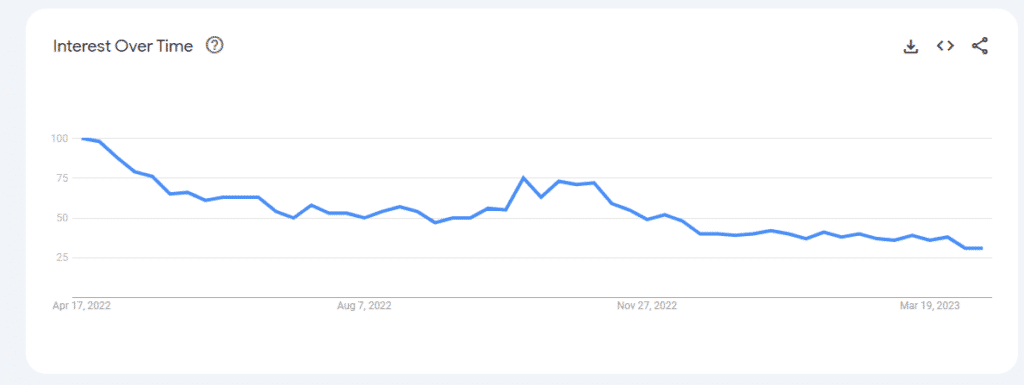
How is the market reacting?
A few months ago the Metaverse was a promising trend, with businesses investing in new creations and acquisitions, but now the scenario does not look so good.
The Wall Street Journal even titled one of its articles about the subject as “The Metaverse Is Quickly Turning Into the Meh-taverse.” This publication mentions the backwards moves regarding the metaverse that big brands like Disney and Microsoft have made recently.
In one of its recent layoffs, Disney cut the metaverse division, and so did Microsoft, which reduced its investments in areas like virtual reality.
According to Bloomberg Sony Group Corp. released the PlayStation VR2 headsets in February and at first, the expectation was to sell about 2 million pieces by the end of March, but the new reality made it likely to sell only around 300,000 units since the metaverse has not been on top of people’s minds.
Besides that, Deloitte’s Global Marketing Trends Report 2025 stated that just 10% of marketers think that metaverse is irrelevant to them.
In addition, we can also mention the Decentraland and Metaverse Fashion Week 2025 with famous brands like Adidas, Dolce & Gabbana, Tommy Hilfiger and many others, that featured digital models on a virtual runway.
There are many other moves that show a group of marketers ditching the metaverse while others are still investing in it.
It’s kind of fascinating how quickly the narrative pivots when enough momentum and money shift elsewhere. I remember when Facebook (I’ll never get used to calling it Meta, honestly) threw everything at making the metaverse feel unavoidable. You could hardly escape conversations about digital real estate, NFT art galleries, or meetings held in legless cartoon bodies. Now, blink and you’ll miss most updates—except, I guess, for the tech journalists politely reporting the latest footnote in a quarterly earnings call. The whiplash is real if you blinked for a bit and then came back to “wait, we’re onto AI now?”
On the flip side, there’s always been a chunk of marketers who like to bet on underdogs, even when the hype moves on. Some agencies are doubling down on metaverse experiences hoping for a comeback, or at least the kind of slow burn that could get quietly lucrative in a few years. There’s something stubbornly charming about that kind of optimism, or maybe stubbornness—hard to tell. Maybe it’s similar to how vinyl records or film photography stuck around: not because everyone’s asking for them, but because a passionate minority just refuses to let go, and sometimes, given enough time, those things turn into “retro-cool.”
The AI timing
In one of my articles, I mentioned that the metaverse received too much visibility in a period that was not very promising for its context. Bringing virtual reality to the spotlight when people were leaving a long period of lockdown, went in different directions to what users were craving for.
Now, during the AI buzz, features have come up in a moment that is more likely to please professionals and businesses. We’ve been living in times of recession, with several companies going through huge layoffs, and doing all they can to save money while running.
Having an artificial intelligence to do some tasks that need to be done by real people creates excitement among businesses. The possibility of saving money without having to hire or maintain an employee for certain activities can sound good to decision makers – note that I am not talking about the quality of the work delivered.
Another interesting point is how the AI features are much more accessible than the metaverse. Anyone can access chat.openai.com and ask their questions or make requests for free, getting a real idea of what the AI can do. In this aspect, the metaverse was not so accessible to anyone who wanted to try it out, and may include other costs that make it a little more difficult to access.
These points can all be a coincidence, but in my view, they make complete sense, being a planned move or just things naturally happening at the right time.
Next steps
The metaverse is decreasing its popularity since marketers and other professionals are more focused on the AI possibilities, since it seems to bring more results at a lower cost. However, I don’t believe that it will be completely cut off from our lives.
As I mentioned before, it is expensive and difficult to understand, so people will still need some time to get used to it, as it also needs to be better developed for potential growth.
At the same time, artificial intelligence spreads across different markets, use cases and possibilities. It is already part of many people’s private and professional lives, and I believe it represents a new era of digital interaction.
Despite this promising scenario, I would not bet all my cards on this new trend, since: some issues with copyrights may appear, the reliability of the information and data provided is sometimes questionable, data protection issues, fake news and the lack of a human sense.
With that in mind, I close this article with a question: we had the metaverse, then AI, so what is coming next?