What Is AI-Generated Text and Imagery?
Popular AI programs like ChatGPT, Bard, and Bing Chat use deep learning algorithms and AI language models to create various texts that seem remarkably human. They can even generate content that sounds like Shakespeare or Bukowski wrote it.
However, since these programs operate by leveraging existing datasets, they can really only imitate human-written text. The resulting material may not contain any obvious errors, but it will also be shallow, devoid of any true originality, and potentially inaccurate.
AI-based image generators—like Bing Image Generator, Stable Diffusion, and Midjourney—also exist. Like AI text programs, these systems leverage machine-learning technology and vast datasets to create a wide range of graphics.

Why Marketers Should Be Concerned About AI-Generated Content
To be fair,a0AI technology and content marketinga0can work well together. For example, AI tech is terrific for finding errors in code, aiding in research, or brainstorming ideas.
What it can’t deliver is originality, which is the X-factor that truly sets a particular piece of marketing content apart.
However, the universal accessibility of AI content-writing tools means AI-generated content is everywhere and anyone can produce it.
And whilea0Google’s take on AI contenta0doesn’t necessarily condemn it, the lack of originality will always keep AI-based text from being genuinely equivalent to human-written material.
As a marketer, you need a reliable way to know if the content you receive from freelance writers or guest bloggers was truly created by humans. An AI detection tool can help you evaluate this material accurately.
How Does an AI Detection Tool Work?
So how exactly do AI detection tools go about telling the difference between a human-written piece and AI-generated writing that just sounds like it was created by a person? They use natural language processing technology to analyze the content for specific patterns.
To be more specific, an AI detection tool looks at each word in a document and rates the predictability of the word that follows it.
If it finds numerous predictable words, the tool becomes more likely to decide that an AI program wrote the text. Human beings, on the other hand, are much more creative. The things they write frequently deviate from highly predictable patterns as a result.
Some other markers that tend to reveal AI content include:
- Text that sounds shallow or basic
- Repetitious word usage or phrasing
- Short sentences that lack complexity and creativity
- Inconsistent or out-of-date information
Some AI detection tools can also analyze visuals like images and videos. They generally look for pixel patterns and inconsistencies that give AI imagery away.
Although AI detectors differ in some ways, most have features like the following:
- Advanced algorithms to ensure accuracy
- Real-time detection interfaces for identifying different types of AI texts
- Personalized dashboards that help marketers analyze results
- Integration support for various systems, platforms, and tools
Some content production options even come with built-in AI detection. These features ensure that you only purchase 100 percent human-written content.
Top AI Detection Tools
Anyone who needs to tell whether or not content is AI-generated may use an AI detection tool to get to the bottom of things. College professors, teachers, editors, and content marketers can make use of this software. Here’s a closer look at some of the top options out there today.
It’s worth realizing that these detection tools are also in an arms race with the technology they’re designed to flag. As AI models get more advanced—2025’s version looks dramatically more nuanced than what we had just a couple of years ago—detection tools have to constantly improve, retrain, and update their benchmarks. It’s a bit like antivirus software always chasing the latest threat, except in this case, the threat is an uncanny paragraph about cloud storage or skincare tips that just… doesn’t feel quite right.
Sometimes, what gives AI writing away isn’t even technical—it’s a sort of hollow aftertaste, an unexpected uniformity, or a joke that falls a bit flat. Human writers, for better or worse, bring quirks: a tangent here, an oddly specific anecdote there, an opinion that sticks out. These little riffs don’t show up in most AI scripts (at least not yet). It sounds almost cliché, but for now, the best detection tool might still be your gut—at least until algorithms start developing mid-sentence existential crises.
Originality AI
Marketed as one of the most efficient tools of its kind, Originality AI can detect material sourced from all of the most popular AI content generators, including ChatGPT and Google Bard.
This tool is known for catering specifically to online publishers, so it’s a great fit for professionals who need to ensure that freelance content is original and human-made.
- Pricing:a0Operates on a credit-based system with each credit costing $0.01 and is good for analyzing up to 100 words
- Integration:a0Has a Chrome plug-in, so it’s easy to add this tool to your ongoing workflow
GPTZero
GPTZero lets users choose between uploading documents or pasting in snippets of text for analysis. It mainly focuses on detecting AI material from the popular GPT programs (up to GPT-4).
- Pricing: GPTZero is currently a free detection tool
- Integration: API is compatible with pretty much any application you might want
Copyleaks
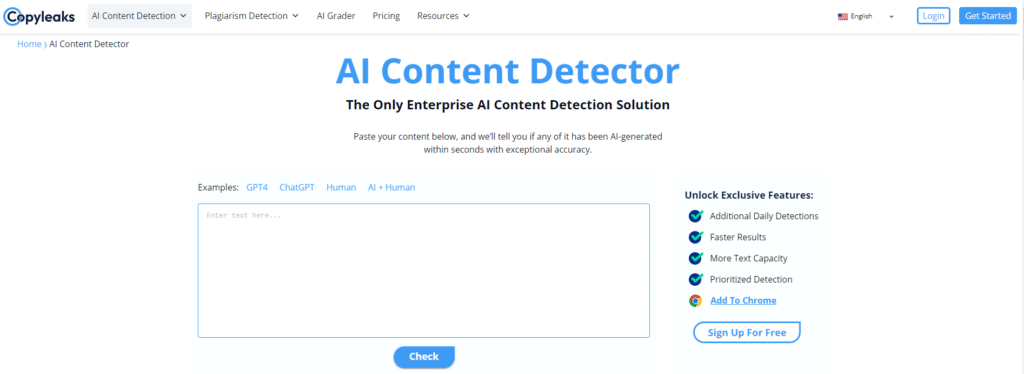
Using Copyleaks is very straightforward; you simply paste a text into the provided box and hit “check.” Copyleaks is adept at identifying AI content from a multitude of popular tools, including ChatGPT, Jasper AI, and many others.
- Pricing: Like GPTZero, Copyleaks is free
- Integration: Has a Chrome extension for ease of use and an API for enterprise users
The best option for you varies depending on what you’re looking to accomplish. Originality AI is the most comprehensive and accurate. But if you’d rather start with a free solution, Copyleaks and GPTZero are both great alternatives.
Final Thoughts
In today’s changing digital landscape, you can’t afford to be without a good AI detection tool.