What Does “High-Quality Content” Even Mean?
I can feel some eyes rolling at this title, but wait! Come with me, and I’ll give you more details.
As I dive further into the “content production” space, a few things become clear: consistency is vital to achieving results, what is interesting and relevant to users changes often, and exploring new themes is extremely challenging.
SEO experts used well-established criteria to predict performance that have changed since generative AI became more popular. Some criteria are still helpful, but their results are becoming less predictable. However, one thing hasn’t changed: the critical question behind every piece of content is: “What is the most important thing to my client?”
Content creators often focus on what they want to say instead of what their personas need to hear.
While this makes sense for influencers, this is a dangerous strategy for companies. If you don’t know who your persona is, what they need, and how you can help, you won’t be able to position yourself as a trustworthy partner. During a time in which information is plentiful but unreliable, being able to create trust with your customers is invaluable.
It’s no surprise that content generated through AI lacks originality and your brand essence. This is the name of the game: these mechanisms are fed extensive databases, and their objective is to compile information to resolve problems and questions. Hence, by definition, content created through AI won’t be original.
So, to answer the title question: what is high-quality content? It’s content that provides knowledge or entertainment to your persona, according to what they need and think in each stage of the funnel.
This is why it’s so hard to create this level of quality through AI. Even though it’s scalable, sharing information is not as important as sharing experience.
That is why so many companies have new hires shadow more senior professionals. The theory is great, but only someone who experienced a similar problem can empathize with another in the same situation.
However, this doesn’t mean we should rule out AI from our content strategies. Instead, we need to be smart about how to use it.
AI and Content Strategy
Since these models have access to so much data—be it demographic or related to content consumption—AI tools can be a great asset when creating your content strategy.
Using myself as an example, I don’t have a large content base that would let me build a data-driven persona. At the same time, I want something more certain than a proto-persona.
That’s why I used the AI Persona Builder to create a couple of personas to guide me through my first steps in content production. If you’re interested in doing the same, I recommend this excellent article about creating buyer personas; it explains the advantages of using AI to develop personas.
This gave me the North I needed: now I know who my followers are, what they are interested in seeing, and how I can address their wishes.
It’s weird to admit, but before AI tools like these, I’d just flail around in brainstorming sessions, jotting down wild guesses and half-baked themes. Now it’s less guesswork—more “here’s what people are clearly looking for.” I still get it wrong sometimes, but at least the process isn’t just intuition and sticky notes. Not everything AI spits out will be gold, but you have a pretty good shot at narrowing your focus to what clicks with your actual audience.
That being said, there’s still a pretty wide gap between knowing your personas on a spreadsheet and actually speaking to them so they feel heard. You can have mountains of demographic data and still miss the mark, especially if you don’t tweak your tone or context to match real conversations. I’ve noticed that the most useful insights usually surface when I combine AI suggestions with anecdotes or little frustrations I’m hearing from users directly. It sounds time-consuming—and some days, it is—but if you skip that blend, everything just sounds generic in the end.
Generative AI can also help you map frequently asked questions a persona has at each step of the funnel if you supply the right prompts.
Now, I face another challenge: how do I show search mechanisms that I provide high-quality content? While a few criteria are important—such as engagement, time spent on the page, shares, and likes—don’t forget about domain authority.
As spam seems to flood the internet, finding top-quality backlink opportunities is getting harder. AI can also help you with that. Through tools such as the AI Backlink Matcher, these models can understand your niche, keywords, and content to match you with potential partners with similar domain authority.
Another of my favorite uses for AI is making SEO easier. I work with content marketing and content strategy, but I’m far from an SEO professional. It’s a lot of hard work, and I don’t think anyone who gets into digital marketing considers it an easy topic to grasp.
When reading “AI Trends for Marketers” from HubSpot, I saw that 84% of marketers say AI effectively aligns web content with search intent.
I tested it for myself, and now I use two tools in my SEO strategy: SpyFu helps me analyze other creators and map out possible keywords to use, while Surfer SEO helps me understand the best titles, subtitles, and FAQs associated with the key sentence I want to produce content about.
Yet, believe it or not, these are not my main problems today. Since I’m at the beginning of my path as a creator, I’m still struggling to implement an editorial calendar due to a simple problem: I don’t have enough content ideas.
In an era of unlimited content, are any themes relevant and original?
Using AI to Discover New Topics
As we discussed, Artificial Intelligence models have access to lots of data and are good at matching content with intent. I’ve recently been trying to take advantage of that by using it to list possible content ideas.
I’ve been testing 80% topics recommended by AI and 20% focused on social media trends. I cannot tell you if it works, as I don’t have enough data yet—stay tuned. What I can say is that this has lifted a heavy burden off my back: not having to worry about 80% of my content lets me focus on ensuring 100% of it is high quality.
Can AI create content for me? Of course, it can. However, it won’t be original or mine.
I use its database to direct and accelerate my progress. Instead of researching for hours to determine the best possible topics, I can just ping the AI Content Idea Generator. With the extra time, I focus on production: script, light, settings, etc. I can be sure what I deliver will speak to my audience every time—and I’ll be proud to say I created it.
AI Content Idea Generator: What Is It and Why Use It?
This tool focuses on helping content marketing professionals find the best topics and themes for their content in a data-driven and personalized way.
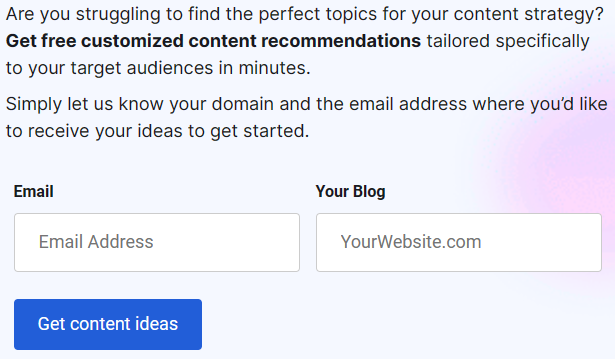
To me, the best part is not worrying about including the correct prompt. Since it only requires my email and URL, I don’t need to be mindful of using terms and sentences that might negatively impact the usefulness of the results.
Based on your domain, this tool will highlight which themes and keywords are most relevant to your persona and provide content ideas and briefs, so you or a copywriter can write your content.
My favorite way to use it so far has been helping me create my editorial calendar. Consistency and frequency are invaluable to content creation. When we don’t have to worry about creating something new and innovative multiple times each week, it’s much easier to map out our explorations during that period.
Free Version vs. Premium: What’s the Difference?
This is the best type of news: a free version of this tool is available for everyone.
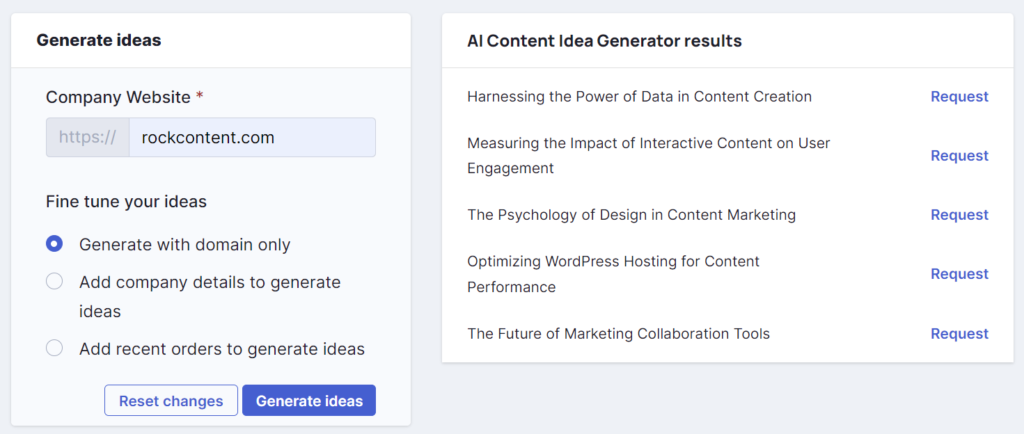
If you have never worked with this kind of tool or want to experiment with it before committing, you can go to the free version of the AI Content Idea Generator and input your email and domain.
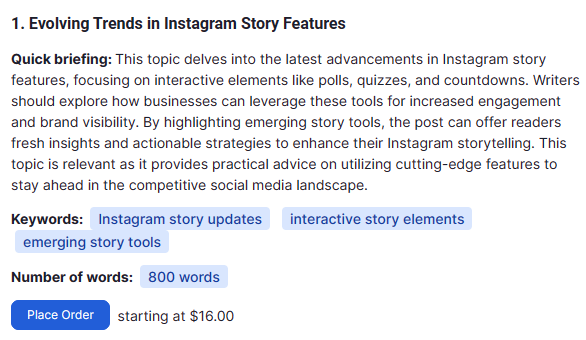
A list with topic suggestions, briefs, and keywords will be sent to your inbox, and you can choose what fits you best. In my case, it took four minutes, and I got a list with five recommendations.
If you are interested in knowing more about it or want to have unlimited suggestions, you can access the premium version and gain additional advantages:
- It’s always available on the platform’s homepage.
- Interact with the tool and give positive and negative feedback.
When reviewing the tool’s suggestions, you can “Like” or “Dislike.” Based on your selection, the AI will provide more recommendations in line with your preferences. This will help the model understand your needs and suggest relevant topics.
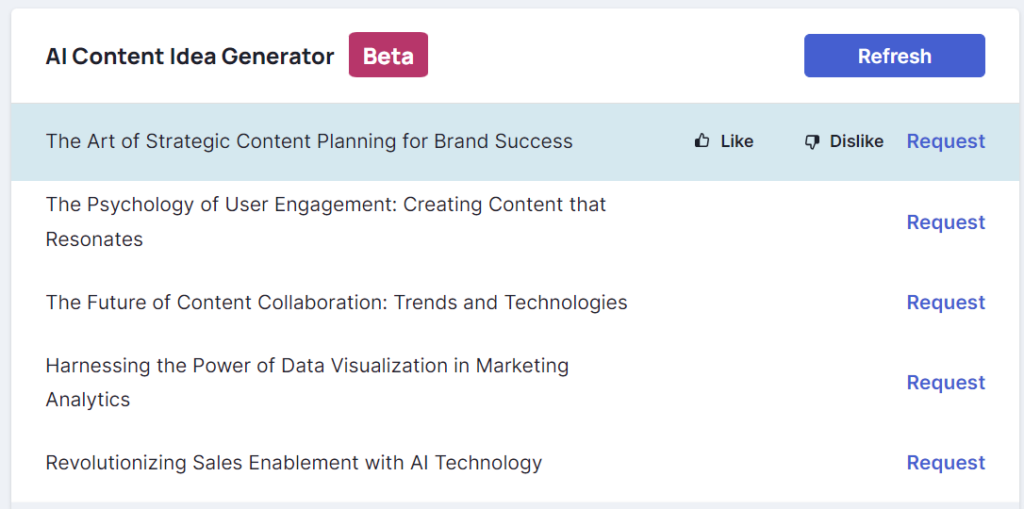
- Get unlimited recommendations.
The “Refresh” button will let you ask for new suggestions as often as needed.
- Order content in one click.
If you like a suggestion, you can click “Request” and be sent directly to the “Place Order” screen. There, you’ll be able to select human talent to write your content, and you can provide details about your brand, your persona, and any customizations you’d like represented in your content. The creative brief will be filled out according to your chosen theme.
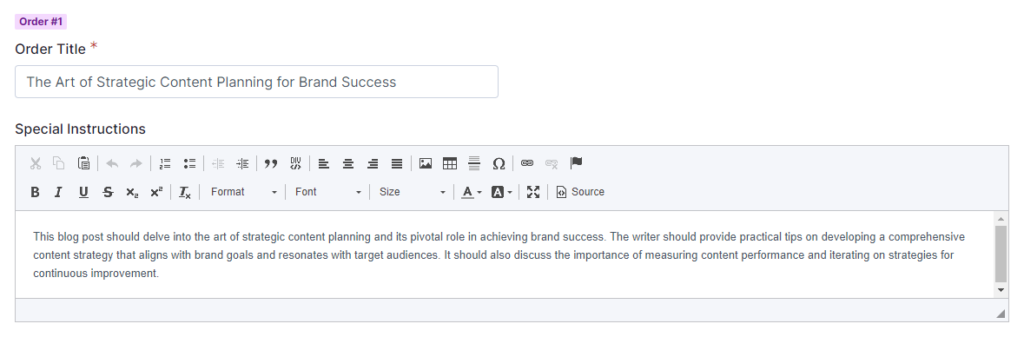
- Give the tool more details so your content can be more relevant to your needs.
The premium version lets you choose if you want to give more details about your company, and you can even ask it to provide topics based on your recent orders on the platform. Both options will give you access to better and more relevant suggestions.
Conclusion
Generative AI doesn’t need to be—nor should it be—limited to copy creation. Raw bot material sucks the essence out of your brand and erases any differences between you and your competitors.
Instead, opt for tools that will help you bring identity to your content. Use AI to aid you when creating strategies, automate repetitive tasks, and even help you map out which content to explore.
When human creativity needs a little push in the right direction, it’s always possible to use data to help us see new paths.